Photo: Torstein Lund Eik / ©Equinor
New test and development arena aims to strengthen Norway’s position in marine robotics and support safe, efficient energy production.
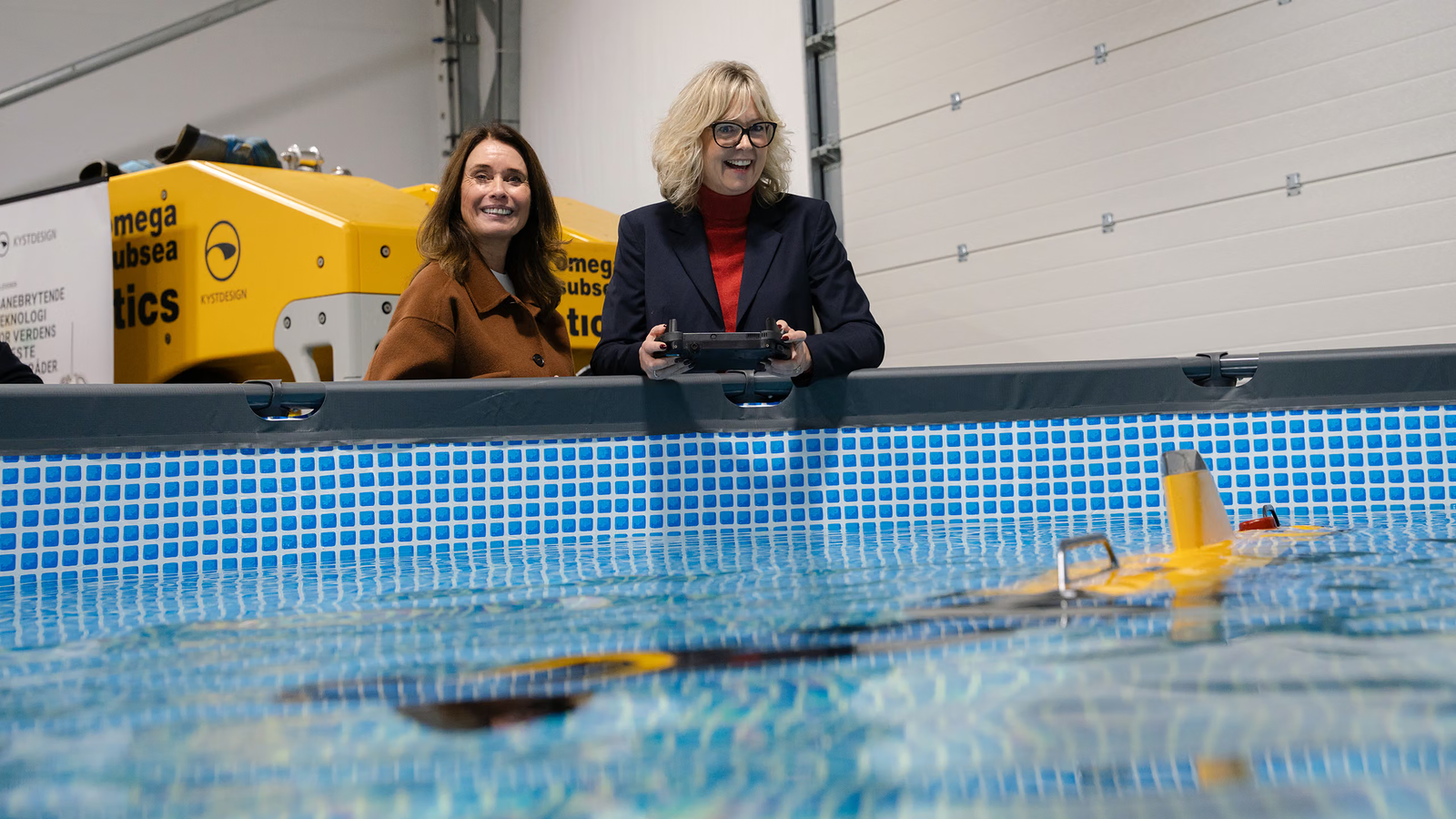
On 28 October the Kårstø Marine Robotics Centre (KNARR) opened, a new facility dedicated to the testing, qualification and development of marine robotic technologies.
The centre, located at the processing plant at Kårstø in Tysvær, will be used for testing, qualification and development of marine robotics.
KNARR will be Norway’s and one of the world’s first test centres of its kind connected to a facility in operation and will make it possible to develop technology in an already operational environment.
The centre will be available for use across maritime industries, and will, among other things, establish solutions for inspection, autonomous operations, environmental monitoring, securing and maintenance of offshore installations.
The centre was opened by Minister of Research and Higher Education, Eileen Fugelsnes, and builds on an already strong Norwegian research environment in marine robotics.
New technology for safe and competitive production
“The Norwegian continental shelf is important for a reliable and secure supply of oil and gas to Europe, and technology is crucial for maintaining oil and gas production and getting more value out of existing fields and infrastructure. At the KNARR centre, we can test and mature technology that makes offshore operations safer, more efficient and more data driven. This is done in close collaboration with suppliers, research communities and industry partners,” says Hege Skryseth, executive vice president for Technology, Digitalisation and Innovation in Equinor.
KNARR is an extension of several established test centres for the early phase of technology testing. Three test areas have been set aside in water depths of 25, 140 and 250 metres, respectively.
Three kilometres of subsea cable and associated electronics have been laid to test sensor technology over time. Together with existing power cables, export pipelines and subsea structures, this provides an opportunity to test, among other things, distributed acoustic sensing (DAS). Equinor and Gassco have so far set aside NOK 16 million to establish the centre, with the possibility of expanding the facilities for new functionality in the future.